
Beyond the Basics: Conquering the Hidden Complexities of PTP Time Synchronization
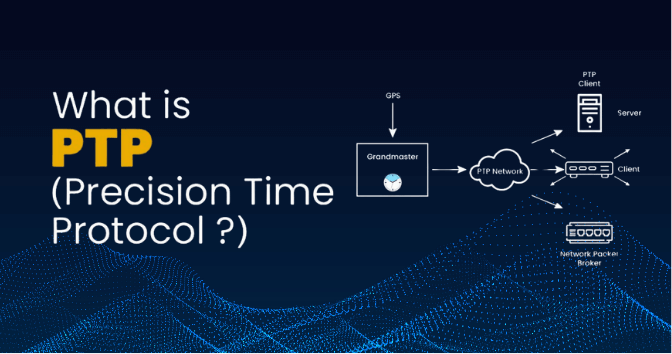
Precision Time Protocol (PTP/IEEE 1588) is the standard for delivering synchronization over packet networks with nano-second accuracy. This level of performance makes it the timing technology of choice for 5G, digital substations, and other critical infrastructure. While the basic concept of a PTP server sending time to clients seems straightforward, achieving true precision requires the network design to overcome a series of complex, often-hidden network challenges.
Among the most critical of these are Packet Delay Variation (PDV) and its insidious cousin, Network Asymmetry. For network engineers, understanding and mitigating these issues is the key to moving from a “working” PTP deployment to a truly reliable and accurate one.
The Obvious Enemy: Packet Delay Variation (PDV)
PDV is the variation in delay that timing packets experience as they travel through a network. Every time a packet passes through a switch or router, it can be momentarily queued behind other traffic. This delay is inconsistent, creating “jitter” in the packet arrival times.
- Impact: High PDV makes it difficult for a PTP client clock to distinguish the true timing signal from network noise, forcing it to rely heavily on its internal filtering algorithms.
- Mitigation: The primary solution for PDV is a well-designed network with strategically deployed Boundary Clocks. A Boundary Clock terminates the incoming PTP reference signal on one port. Another port is configured as a PTP server to endpoint devices. This decreases PDV and increases overall synchronization accuracy.
The Hidden Enemy: Network Asymmetry
Network Asymmetry is a more fundamental and challenging problem. PTP calculates the network delay by assuming the time it takes for a packet to travel from the server to the client is the same as the time from the client back to the server. Asymmetry occurs when these two paths have different delays.
Causes of Asymmetry:
- Different Physical Paths: In many routed networks, the forward and return traffic paths are not identical. A packet might take three hops to get to a client, but five hops to get back, creating a significant and permanent delay difference.
- Different Wavelengths/Fibers: In optical networks, transmit and receive signals often travel on different physical fibers or different DWDM wavelengths, which may have slightly different physical lengths and propagation delays.
- Congestion & Queuing Bias: Some network equipment may prioritize certain traffic queues differently for ingress versus egress traffic, introducing a subtle, load-dependent asymmetry.
The Impact: Unlike PDV, which is variable noise that can be filtered, asymmetry introduces a constant, hidden time error. The PTP protocol has no way of knowing this asymmetry exists and will incorrectly calculate the time offset. For example, an asymmetry of just 200 nanoseconds will result in a permanent 100-nanosecond error at the client clock—enough to violate many 5G requirements.
Solutions for Conquering PTP Complexities
Solving these challenges requires a combination of smart architecture and advanced technology.
- Design a Symmetrical Network: The best solution is to design a network that is as symmetrical as possible. Using DWDM transport with bi-directional optics on a single fiber is a highly effective way to ensure the forward and return paths are virtually identical, drastically reducing asymmetry.
- Utilize Advanced PTP Algorithms: Modern PTP solutions, like those in the Microchip TimeProvider series, can incorporate advanced algorithms (e.g., Assisted Partial Timing Support – APTS) that measure and compensate for asymmetry when a secondary reference (like GNSS) is available at the client.
- Deploy High-Performance Boundary Clocks: Using high-quality BCs (like ITU-T Class C or D) minimizes the PDV introduced at each hop, making the client clock’s job of filtering the remaining noise much easier.
How Syncworks Helps You Master PTP
At Syncworks, we have experience with the complexities of packet timing. Our expertise goes beyond the basics to ensure your PTP deployment is not just functional but truly precise and resilient.
- Network Design Services: We start by analyzing your transport network to identify potential sources of PDV and asymmetry. We design solutions—whether over MPLS, Carrier Ethernet, or DWDM—that are designed to minimize these errors from the start.
- Expert Deployment & Validation: Our field team uses specialized test equipment to measure real-world network performance, validating PTP accuracy and ensuring the system is performing to spec before it goes live.
- Lifecycle Support: Through SyncCare, you have access to our team of experts who can help troubleshoot even the most complex, intermittent timing issues.
Don’t let the hidden complexities of PTP compromise your network’s performance. Partner with Syncworks to build a synchronization architecture that is accurate, stable, and built to handle the challenges of the real world.
Click here to schedule a consultation call with a timing expert today.
